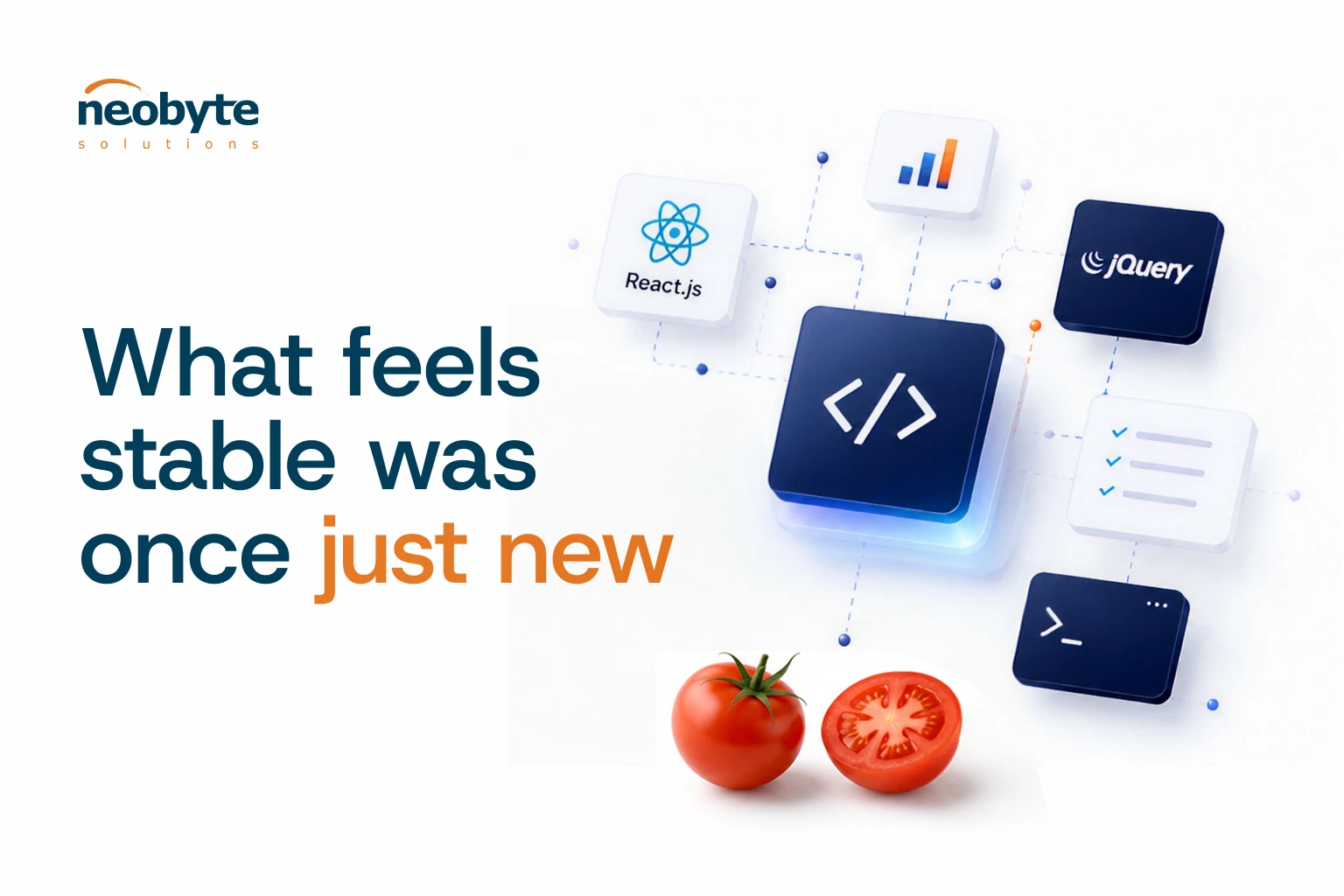
What feels stable was once just new.
What we consider stable today often started as something new, something people rushed to try, something that carried its own kind of excitement.
It is easy to forget that at the beginning, those “boring” tools were once a hype.
They did not arrive as stable choices, as long-term companions you could rely on. They became that, slowly, almost quietly, settling into your daily tasks, through time and repeated use, and through people choosing them again and again, even after the excitement faded.
Starting a new project does not necessarily mean starting a new tech stack. Sometimes the choice is intentional, shaped by repeated R&D and exposure to projects built with a specific stack. You keep seeing the same technology everywhere until the older solution starts feeling outdated, even if it still works perfectly well.
It begins with a feeling.
They rarely stay limited to one domain
Trends create hype no matter the domain they belong to.
You see a celebrity presenting a new natural line of hair products, carefully grounded in science, something that understands you and works with you. And for a moment, it feels like that product could do more than what it promises. It starts to extend beyond its purpose, touching things it was never designed to reach.
It is no longer just about hair.
It becomes something else, something harder to name, but easier to believe in.
The same thing happens in programming.
At one point, moving from jQuery to React felt almost revolutionary. React promised cleaner interfaces, reusable components, a different way of thinking about applications. And slowly, it stopped being just a UI library.
People began using it everywhere.
Not only for web interfaces, but for mobile apps, desktop software, terminal interfaces, even things it was never originally designed for.
It became more than a tool.
It became a mindset.
Does this sound familiar?
The same pattern, in a different language
In tech, the same movement exists, just in a different language.
You see someone experienced showcasing a new technology. The way they move through it feels effortless. The code looks clean, the structure seems elegant, everything appears to fall into place without resistance. And without noticing when it happened, something shifts inside you.
You start thinking about new projects. Or about old ones. You look at what you have built and, for a brief moment, it feels outdated, as if it belongs to a different time.
Nothing changed in the code.
But something changed in how you see it.
Faster than we can fully process them
Trends move faster than we can process them.
The catch is… trends override at the speed of today to tomorrow.
What feels current today becomes distant tomorrow. We used to joke that JavaScript libraries appear more often than anything else, and even if it was said lightly, it pointed to something real. The speed is not just about creation, but about attention, moving from one thing to another without staying long enough to fully understand.
And once attention moves, where it goes next is not always clear.
The Taste of Hype
Tasting a bad tomato first thing in the morning is the worst feeling.
When your stomach is empty, everything is sharper. The taste is stronger, more present, harder to ignore. It settles in a way that lingers, even if the rest of the day has nothing to do with that moment.
Hype works in a similar way.
You might not go looking for it, and you might not follow trends. Not intentionally, at least. And still, they find you. An autoplay video, or an ad that starts before you decide to watch it, a message that appears in front of you without being invited.
If it is well crafted, it stays with you. If it is not, you move on. And sometimes, if it misses completely, you reject it without giving it a chance.
But in all cases, something already happened.
A first taste.
What stays after the first taste
What you consume matters, not just for your plate.
There is another layer of consumption, quieter, less visible, but just as present. Pieces of content, fragments of ideas, small impressions that pass through you and leave something behind, even when you do not notice it.
It turns your online experience into something that resembles a plate you did not prepare. You keep tasting things in an order you did not choose, influenced by ingredients you did not inspect, shaped by a logic that is not yours.
Some disappear quickly. Others stay longer than they should. Some become part of how you see things.
Not everything new is better, just as not everything stable is outdated, and not everything that feels right in the moment truly comes from you.
Maybe the question is not what is trending.
Maybe the question is what you are allowing to become your first taste.