WordPress optimization in 2013 vs WordPress optimization in 2026.
Back in 2013, we published an article about increasing the speed of a WordPress blog. At that time, website optimization already mattered, though the web looked very different compared to today.
Sprite sheets were commonly used to reduce HTTP requests, mobile optimization was still evolving, and many websites focused mainly on desktop performance. Since then, WordPress, browsers, hosting technologies, and user expectations have changed significantly.
In 2026, website speed is no longer only about faster loading times. Performance now influences user experience, mobile usability, SEO visibility, accessibility, and even website security in some situations.
At the same time, some optimization principles remained surprisingly relevant over the years. Good hosting, optimized assets, efficient code, and controlled plugin usage still play an important role in maintaining a fast WordPress website.
This updated article revisits some of the classic optimization ideas while also looking at how WordPress performance practices evolved over time.
As a frontend developer back in 2013, I spent a considerable amount of time building CSS sprite sheets and trying to reduce asset requests as much as possible.
As the developer I am today and moving into 2026, I rarely even think about sprite sheets anymore.
The technological progress of frontend development often feels more like an ascension than a gradual evolution.
I cannot say frontend development became easier over time. Modern projects are often significantly more complex. At the same time, some tasks that once felt overwhelming became much easier or simply unnecessary thanks to the technologies and tools developed over the years.
What Stayed Relevant Since 2013
Some optimization practices changed dramatically over the years. Others remained important regardless of trends or technologies.
| Optimization Practice | Status in 2026 | Notes |
|---|---|---|
| Reliable hosting | Still essential | Modern hosting infrastructure matters even more today. |
| Image optimization | Still essential | Modern formats like WebP and AVIF improved efficiency. |
| Caching | Still essential | Modern caching systems became more advanced. |
| Lightweight themes | Still essential | Heavy themes may still affect loading times and usability. |
| Plugin management | Still essential | Excessive plugin usage may affect performance, maintenance complexity, and security exposure over time. |
| JavaScript optimization | Still essential | Modern websites rely heavily on frontend performance. |
| Sprite sheets | Less common | HTTP/2 and modern asset loading reduced their importance. |
| Desktop-first layouts and pixel-perfect workflows | No longer sufficient | Responsive and mobile-first development became standard. |
| Aggressive plugin-based minification | Situational | Excessive optimization plugins may introduce conflicts, maintenance complexity, or additional security exposure. |
| Manual browser-specific CSS fixes | Much less common | Modern browser support became more consistent. |
| jQuery optimization | Still relevant in many projects | Many WordPress ecosystems still rely on jQuery. |
Some older optimization techniques became less common over time. Sprite sheets are one example. In 2013, they were frequently used to reduce multiple image requests into a single file. Modern browsers, HTTP/2, CDNs, and frontend workflows changed how developers approach asset delivery today.
Many frontend developers from that period probably still remember spending hours carefully building and positioning sprite sheets. Despite the technical limitations of the time, there was something satisfying about making them work correctly.
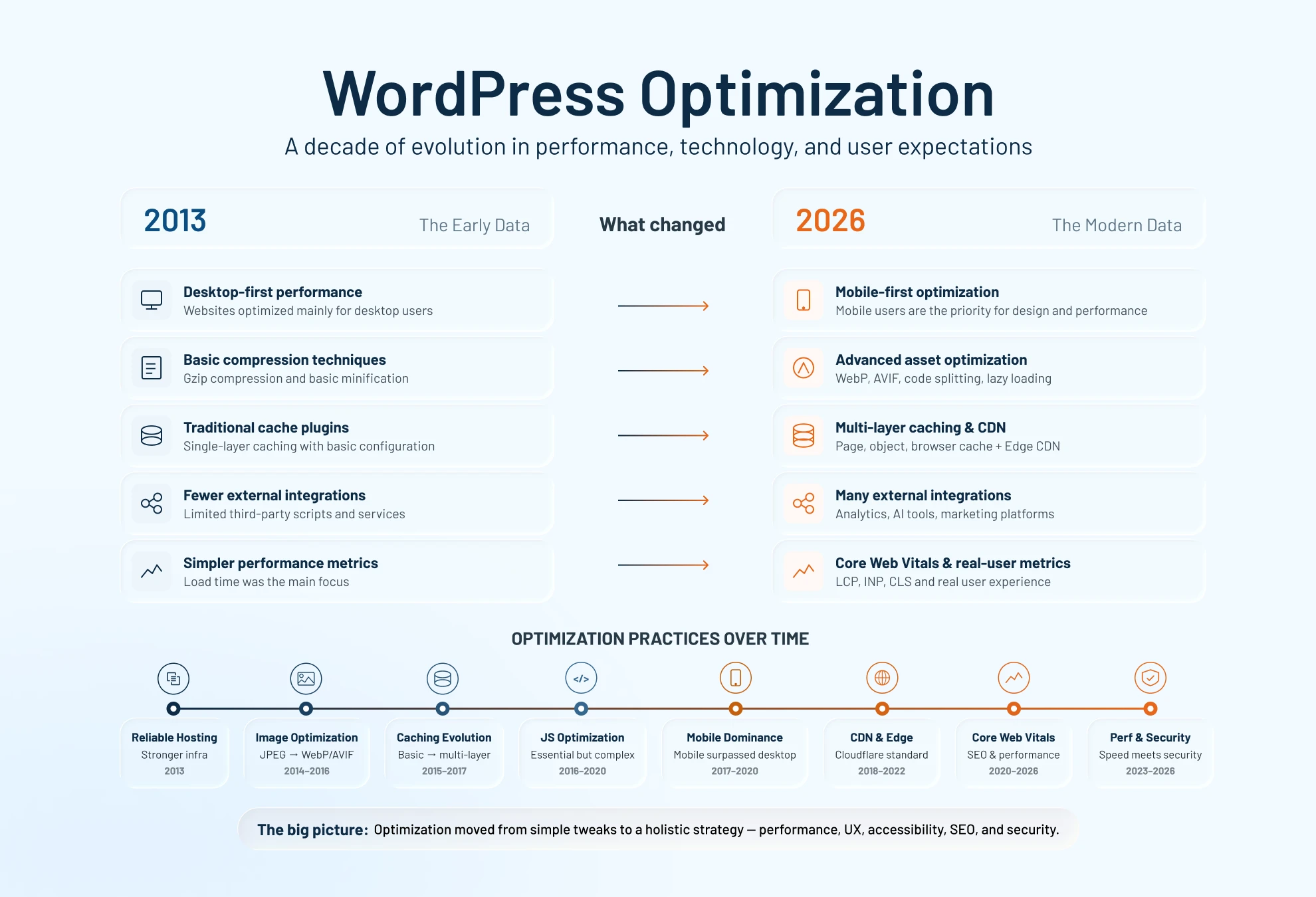
What Changed Between 2013 and 2026
The priorities of WordPress optimization evolved together with the web itself.
| Around 2013 | In 2026 |
|---|---|
| Desktop-first performance | Mobile-first optimization |
| Basic compression techniques | Advanced asset optimization |
| Traditional cache plugins | Multi-layer caching and CDN ecosystems |
| Fewer external integrations | Analytics, chat widgets, tracking scripts, AI tools |
| Simpler performance metrics | Core Web Vitals and real-user measurements |
Mobile optimization became a non-negotiable aspect of modern web development. Many websites now receive most of their traffic from mobile devices, which means performance issues become visible much faster for users.
Google PageSpeed Insights and similar tools also evolved over the years. Today, these platforms help identify potential performance issues, though scores alone should not be treated as the only indicator of website quality.
Modern optimization discussions now frequently include technologies and platforms such as LiteSpeed servers, Cloudflare CDN integrations, and Google’s Core Web Vitals metrics like LCP, INP, and CLS.
Mobile traffic also became dominant for many industries over the years, which significantly changed how developers approach frontend performance and responsiveness.
WordPress Performance Is More Complex Today
Modern WordPress websites often include visual builders, WooCommerce functionality, marketing integrations, video content, third-party APIs, tracking scripts, and dynamic features.
Each additional system may contribute to resource usage, loading times, or frontend complexity.
Modern websites naturally became more dynamic and feature-rich over time. Performance optimization now often involves balancing functionality, usability, third-party integrations, and loading speed together.
Even technologies that some developers considered outdated continue to remain useful in many environments. jQuery is a good example. While modern JavaScript frameworks became more common, many developers still appreciate jQuery for its simplicity, reliability, and integration with existing WordPress ecosystems.
Optimization Is Much More Than Page Speed
Website optimization may also contribute to better stability and security practices.
For example:
- reducing unnecessary plugins may reduce maintenance overhead,
- optimized code may lower server resource usage,
- updated systems may help reduce compatibility risks,
- controlled external scripts may improve both performance and security visibility.
Different websites benefit from different optimization strategies. A WooCommerce platform, a presentation website, and a content-heavy publication rarely face the exact same performance challenges. Comparing them directly would sometimes feel like comparing apples to oranges.
In many situations, the best results come from combining multiple smaller improvements applied correctly and tested carefully.
Revisiting Our 2013 WordPress Speed Recommendations
| 2013 Recommendation | How It Evolved in 2026 |
|---|---|
| Choose the right hosting | Hosting remains essential, though modern cloud infrastructure, LiteSpeed servers, and edge caching changed performance expectations. |
| Use a content delivery network | CDNs became a standard part of many optimization strategies. |
| Use a caching plugin | Modern caching systems are often multi-layered and integrated with hosting environments. |
| Use scaled images | Modern image formats like WebP and AVIF improved optimization workflows. |
| Remove unnecessary plugins | Still highly relevant in 2026. |
| Use CSS sprites | Less common today due to HTTP/2 and modern asset loading methods. |
| Use as little dynamic content as possible | Dynamic functionality became more common, especially in WooCommerce and interactive websites. |
| Move scripts to the footer | Script management evolved with defer, async, and modern loading strategies. |
| Optimize databases regularly | Still relevant for many WordPress websites. |
| Reduce external requests | Even more important due to analytics, ads, tracking tools, and third-party integrations. |
| Minify JavaScript and CSS | Still useful in some cases, though modern build systems changed implementation methods. |
| Use Gzip compression | Modern servers may also use Brotli compression alongside or instead of Gzip. |
Final Thoughts
This article also became a small retrospective of frontend development itself, revisiting WordPress optimization practices after more than a decade of frontend evolution.
WordPress optimization changed considerably between 2013 and 2026. Some techniques disappeared, others evolved, and new performance standards appeared together with modern browsing habits.
Even though the technologies changed considerably, the objective remained relatively similar over the years: building websites that feel fast, stable, accessible, and pleasant to use.