Why Digital Transformation Projects Fail and How to Avoid It
A practical guide for business leaders preparing to modernize their processes, systems, and ways of working.
Most of the time, digital transformation projects begin with a legitimate business need. Processes may be too slow, information may be fragmented across disconnected systems, or existing tools might no longer support the way the company operates.
A new platform, automation initiative, or data solution may appear to offer a clear path forward. However, introducing new technology does not automatically improve the processes, decisions, and collaboration around it.
This article examines five common reasons why digital transformation projects fail, the warning signs decision-makers should recognize, and a more controlled approach based on discovery, a focused pilot, and evidence-led scaling.
The purpose is not to assign blame, but to examine recurring patterns that can weaken a project and offer a practical basis for avoiding them.
Digital Transformation Is More Than a Technology Project
Digital transformation is often associated with new platforms, automation, cloud services, or data systems. These technologies can support meaningful change, but they are only one part of the project.
A transformation initiative can affect workflows, responsibilities, decision-making, customer interactions, internal collaboration, and the way information is collected and used.
Digital transformation should therefore be treated as an organizational project supported by technology. A system can work exactly as specified and still deliver limited value if it does not reflect how the company operates or the needs of the people using it.
Five Reasons Why Digital Transformation Projects Fail
Digital transformation projects often begin to fail before implementation, when unclear priorities, incomplete planning, or poorly informed decisions shape them from the start.
1. Strategy Is Defined Too Late
A project may begin with a preferred platform, a fixed technology stack, or a list of required features before the business problem has been properly defined.
In some projects, especially those governed by funding conditions or detailed contracts, certain features must be implemented because they were included in the approved scope. These requirements may be necessary for compliance, but their inclusion does not automatically create value for users or improve the underlying process.
When strategy comes later, requirements expand, teams interpret the objective differently, and early technical decisions can restrict the project before its actual needs and constraints are understood.
The business problem, expected outcomes, scope, and key tasks should be documented with accuracy and clarity. This provides a stronger basis for selecting features, evaluating technologies, and measuring progress.
2. People Are Not Properly Involved
People may struggle with change because they lack the context, access, or support needed to contribute effectively.
New team members joining a mature project may need to decipher years of code, decisions, and established practices without sufficient onboarding or documentation. At the beginning of a project, a similar issue appears when each person receives information only about their own fragment of work.
When software is intended to digitize manual work, observing those workflows directly can be especially valuable. Designers, developers, analysts, and other contributors can understand the sequence of actions, practical constraints, exceptions, and information people rely on every day.
Meaningful involvement requires more than assigning tasks. People need enough context to understand the project as a whole and how their decisions influence the final solution.
3. Technology Decisions Are Made Too Early
A technology stack should not be evaluated only by its current features or popularity. Its long-term viability can affect maintenance costs, delivery speed, and the project’s ability to evolve.
Important considerations include:
* long-term support
* ease of updates and upgrades
* quality of online documentation
* strength of the developer community
* licensing and usage costs
* flexibility
* reputation of the technology and its maintainers
A well-established ecosystem can provide security updates, maintained dependencies, reliable documentation, and access to experienced specialists.
Free-to-use technology may reduce initial costs, but licensing is only one part of the decision. Technology choices should follow the project’s requirements and remain maintainable throughout its expected lifetime.
4. Success Criteria Remain Unclear
A project can be delivered on time, remain within budget, and include every agreed feature while still producing less value than expected.
Success criteria should create a simple point of comparison between what was requested and what was delivered. The project needs a clear list of desired outcomes that can be reviewed after implementation.
For example:
* Were the required manual steps reduced?
* Is the necessary information easier to access?
* Were processing times improved?
* Did the number of errors decrease?
* Are the intended users working with the new system?
* Did the project solve the business problem it was created to address?
The final evaluation should not depend on broad statements such as “the system works well.” The agreed outcomes should show clearly where the project succeeded, where it fell short, and what still needs improvement.
5. Responsibility and Decision-Making Authority Are Misaligned
A digital transformation project involves decisions across business, technical, operational, and organizational areas. When responsibility is unclear, approvals are delayed and teams may assume that someone else is handling the issue.
Delays often appear when the people doing the implementation encounter situations that were not covered by the original requirements. When they lack the authority to make an appropriate decision, progress stops while they wait for feedback.
An external technology partner can support discovery, implementation, and technical decisions, but they cannot replace internal responsibility. The company still needs people who can clarify priorities, coordinate affected teams, and respond when requirements or constraints change.
Responsibilities and decision-making authority should be communicated through clear internal processes. The business representatives responsible for the project should provide the necessary onboarding, instructions, documentation, and opportunities for questions and learning. This gives each person a practical understanding of which decisions they own, when their input is required, and where escalation is necessary.

Early Warning Signs in a Digital Transformation Project
Warning signs can often be recognized before delays, budget pressure, or adoption difficulties become severe.
These may include:
* stakeholders describing the project differently
* requirements changing without clear priorities
* users being consulted after important decisions have been made
* decisions and approvals remaining unresolved
* teams continuing to rely on old processes
* a pilot expanding before its assumptions are validated
* integrations and data quality being repeatedly postponed
* features being delivered without a clear connection to desired outcomes
One signal alone may not indicate failure. Several appearing together suggest that the project needs clarification before complexity and correction costs increase.
A More Realistic Approach: Discovery, Pilot, and Scale
A more controlled approach is to understand the problem, test a focused solution, and expand based on evidence.
Discovery
Discovery defines the project before implementation begins.
It may include:
* the business problem and expected outcomes
* current workflows and responsibilities
* users and affected teams
* available data and data quality
* existing systems and integrations
* technical constraints and project risks
The result should be a shared understanding of what needs to change and what the first version of the solution should achieve.
Pilot
A pilot tests a focused solution against a clearly defined problem.
It may evaluate:
* whether the proposed workflow is practical
* whether users can work with the solution
* whether integrations are feasible
* whether the expected outcome can be observed
* which assumptions need revision
The pilot should remain limited enough to produce useful evidence before the project expands.
Scale
Scaling extends a validated solution to more users, processes, or business areas.
It may require:
* refined workflows and integrations
* stronger security and governance
* updated documentation
* training and user support
* maintenance and upgrade planning
* clearer operational ownership
Expansion should reflect both the evidence gathered during the pilot and what the organization is prepared to support.

How Neobyte Solutions Approaches Digital Transformation Projects
At Neobyte Solutions, digital transformation begins with understanding the business context. Before recommending technology, we examine the problem, current workflows, people involved, available data, and systems already in use.
The first objective is to create a clear project definition. This includes expected outcomes, responsibilities, technical constraints, integration requirements, and the criteria that will later be used to evaluate the result.
Where appropriate, the project can begin with a focused pilot. This allows workflows, integrations, technical assumptions, and user adoption to be tested within a controlled scope. The evidence gathered provides a stronger basis for deciding what should be refined and how the solution can be expanded.
This approach keeps project decisions connected to the needs and capabilities of the business.
Is Your Company Ready for Digital Transformation?
A short readiness assessment can reveal whether a project has enough clarity to begin.
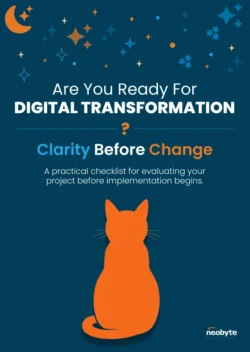
The Are You Ready for Digital Transformation? checklist helps you review four important areas before implementation:
* strategy and expected outcomes
* people and responsibilities
* workflows, data, and technology
* pilot readiness and long-term support
Use the checklist to identify what is already clear, what still requires discussion, and which decisions should be addressed before the project moves forward.
Download the Digital Transformation Readiness Checklist
For a broader evaluation of your company’s current digital maturity, you can also complete the Neobyte Solutions Eligibility Assessment.
Final Thoughts
Digital transformation depends on making informed decisions throughout the project.
A clear reason for change, realistic priorities, measurable outcomes, suitable technology, and well-defined responsibilities create a stronger foundation for implementation.
Clarity connects all these elements. It allows people to understand what the project should achieve, what their role is, which decisions they can make, and how the final result will be evaluated.
Digital transformation succeeds through clarity before and during implementation, not through technology alone.
A controlled process based on discovery, a focused pilot, and evidence-led scaling gives the organization time to validate important assumptions before complexity increases.
Our Recommended AI Service
If this article reflects a challenge your business is facing, we suggest starting with our AI-Accelerated Delivery service. Together, we can identify the next steps that could bring the most value to your business.

Ready to Bring More Clarity to Your Digital Transformation?
Contact Neobyte Solutions to discuss your digital transformation project and requirements.